Showing posts with label thai trips. Show all posts

9/29/09

Thai Yoga Massage


Thai Yoga Massage

What is traditional Thai Massage?

Traditional Thai massage is an ancient form of healing believed to originate from the time of Buddha. Thai massage techniques differ from the scooping strokes of Western massage; it is described by some as a kind of passive yoga. The Thai method uses two primary procedures - applying deep, consistent pressure to specific nerves, tendons and ligaments, and a wide variety of passive stretching movements manipulating the skeleton in order to balance the functions of the body. The theoretical basis of traditional Thai massage lies in the theory of energy lines running through the body. Out of the 72 000 energy lines said to be in existence, the focus is on 10 major lines. Working on important acupressure points along these energy lines helps to remove blockages which allows free flow of energy through the body, balancing the body's energy system. Thai massage techniques display a knowledge of the inner workings of the body which has developed over centuries of practice. In Thai yoga massage it is not just the hands that are used but also the therapist’s feet, forearms, knees and elbows. Traditional Thai massage is applied on a mat on the floor, the work is done fully clothed and no oils are required. The effect of Thai massage is uniquely relaxing as well as energizing. The body regains flexibility and ease of movement, and the quiet meditaive atmosphere gently promotes a calm alertness. Tension and toxic material is released from the joints, muscles and connective tissue. The movements also help to adjust the skeletal structure, relieve muscular and joint tension, and stimulate the internal organs.

Thai massage schools in Thailand

During your visit to Thailand you are sure to receive at least one Thai massage. If you have never experienced one before you will be surprised by the positive effect it has on both your mind and your body. You may wish to learn how to offer the same experience to someone else, in which case you can combine your travels to Thailand with learning Thai massage! There are a number of schools in Thailand for traditional Thai massage. For southern style Wat Po temple in Bangkok is the leader. southern style Thai massage is faster paced and less repetitious than northern styles. For the slower and gentler northern style, Chiang Mai is where you need to be. Northern style Thai massage is like the northern people themselves who are slower-paced and a gentler people than their southern neighbours.
If you are interested in taking a Thai massage course in Thailand you can learn Thai massage at Horizon Thai Boxing Camp. Massage is extremely important to our Muay Thai boxers. We have a highly qualified resident masseuse and plenty of Muay Thai boxers for you to practice your techniques on. Our instructor comes from a family with a long history of Thai massage. It is a joy to watch and learn from him. If you would like to book a place on one of our Thai massage courses or ask questions please use the enquiry form.

History of ancient Thai Massage

Ancient Thai massage has a long history of therapeutic healing in Thailand. It is a unique form of bodywork with origins dating back 2500 years. Its roots can be traced back to India. The founder of the practice was Shivaga Komarpaj, a doctor believed to be friend and contemporary to the Buddha. Thailand is situated along the great trade route between India and China and its history and culture, along with its medicine, has been affected by its location. As Buddhism spread out from India, healing medicine spread with it. Thai massage has been passed down as an oral tradition, with a unique style developing in each area of Thailand. Most of the ancient medical texts were destroyed along with the destruction of Ayutthaya in the 18th Century by the Burmese. As an attempt to preserve the tradition of Thai massage what remained was literally carved in stone and set into the walls at Wat Po temple in Bangkok. Wat Po remains a centre of ancient Thai massage teaching in Thailand today. Originally, the Thai people saw illness as an imbalance in the body, mind and spirit, and they would seek help at the local temple. They were treated by the monks with the three elements of traditional Thai medicine:
  • Herbal medicines: These medicines are readily available over the counter at pharmacies in Thailand today, and many Thai herbs are included in regional cuisine with the intent of enhancing health as well as taste.
  • Psycho-Spiritual healing:  This includes various types of visualization practices by the patient, as well as shamanistic rituals performed by the healer.
  • Thai Massage: This formed the backbone of physical treatments.
Rather than just at the temples or perpetuated within families Thai massage is now practiced throughout Thailand, at massage schools, hospitals, in hotels, on the beaches, and seemingly around every street corner where there is an enterprising Thai! Some of these venues are not legitimate, and many therapists have received only minimal training. Yet other venues offer astounding treatments by masters of this healing art. There is much to be learned from traditional Thai massage practitioners within Thailand.

Benefits of Thai Massage techniques

Thai massage has been used for centuries in Thailand to treat degenerative conditions and promote wellness.This ancient form of therapy is beneficial to the young or old, active or inactive, healthy or not so healthy. Thai massage techniques assist the body to return to optimum performance and optimum health, contributing to a sense of ease and well-being and good health. The benefits of Thai massage are boundless. Thai massage heightens awareness, frees blockages in energy flow, invigorates the nervous system, relieves pain and muscle tension, increases the bodies ability to absorb nutrition by stimulating the organs, strengthens and rejuvenates the body, improves circulation of the blood and lymph, increases flexibility and promotes a general feeling of well-being assisting in balancing body, mind and spirit. Thai massage assists elimination of waste and toxic debris collected from physical and emotional strain. Thai massage techniques can be particularly helpful in relieving headaches, migraines, arthritis, whiplash pain, paralysis, numbness and back pain. Our family has a personal story which demonstrates the benefits of properly executed Thai massage techniques. Several years ago Ex, co-owner of Horizon Thai Boxing Camp, received a faulty injection at a Doctors clinic. The injection should have been administered into the vain, but the Doctor mistakenly jabbed it into his leg muscle. Ex very quickly became gravely ill. Following months of intensive hospital treatment Ex was told that he would never walk again. In fact, it was considered a miracle that he managed to survive at all. Ex believes wholeheartedly that Thai massage treatments received on release from the hospital were partly responsible for his full recovery.

Thailand Sports


Muay Thai Boxing

Muay Thai kickboxing is probably the most popular spectator sport in Thailand. Almost anything goes both in the ring and the stands. If you want to watch a Muay Thai fight night there are Muay Thai stadiums all over the country. The wild musical accompaniment, the ceremonial beginning to each match, along with the devastating martial arts action will make it a night to remember. Horizon Thai Boxing Camp promotes monthly Muay Thai fight nights at our Muay Thai stadium in Ban Tai on Koh Phangan island in southern Thailand. If you want to learn Muay Thai kickboxing you are welcome to join our Muay Thai training camp at Haad Tien bay any time.

Kraabi Krabong

This traditional Thai martial art focuses on hand-held weapons techniques in conjunction with Thai boxing techniques. Displays can be seen at festivals and tourist venues. You can learn Kraabi Krabong during your stay in Thailand. We hold occasional Kraabi Krabong seminars at Horizon Thai Boxing Camp.

Sepak Takraw

Another sport indigenous to Thailand is Sepak Takraw, a variant of volleyball played with the feet and a light rattan ball. There are several versions of the game with different rules. In the south of Thailand the game is played with a net. Only the feet and head are permitted to touch the ball. It is amazing to see players perform aerial pirouhettes, spiking the ball over the net with their feet.

Volley Ball

Volleyball is a sport in which two teams, separated by a high net, hit a ball back and forth over the net using only their hands. Each team has a maximum of three hits to get the ball back over the net to the other team. A point is scored if the ball hits the ground in the opponents' court. A team of Katoey (ladyboys) volleyball players made headlines in Thailand when they started a meteoric rise through the national championships. Two films have been made about their exploits. There are beach volleyball competitions at many tourist spots.

Football

Professional football in Thailand is in its infancy, although the English Premiership has a surprisingly large following. Most viallges young men will kick a ball around before sunsets. Organised competitions on Koh Phangan.

9/24/09

Songkran

Songkran

From Wikipedia, the free encyclopedia


New Year celebration, Rodnam Damhua, a traditional way to celebrate with elders. Most Thai people go back to their hometowns to meet their elders.
A truck load of people after a "hit", Chiang Mai, Thailand
The Thai New Year (Thai: สงกรานต์ Songkran, from Sanskrit sankrānthi "astrological passage"; Chinese: 潑水節) is celebrated every year from April 13 to April 15. It coincides with the New Year of many calendars of South and Southeast Asia.
The date of the festival was originally set by astrological calculation, but it is now fixed. If these days fall on a weekend, the missed days off are taken on the weekdays immediately following. If they fall in the middle of the week, many Thai take off from the previous Friday until the following Monday. Songkran falls in the hottest time of the year in Thailand, at the end of the dry season. Until 1888 the Thai New Year was the beginning of the year in Thailand; thereafter 1 April was used until 1940. 1 January is now the beginning of the year. The traditional Thai New Year has been a national holiday since then.

New year traditions

Songkran at Wat Thai in Los Angeles
Water throwing along the western moat of Chiang Mai, Thailand
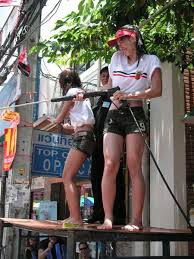
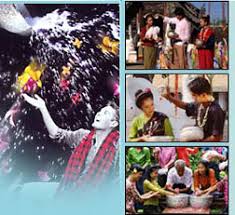
The most obvious celebration of Songkran is the throwing of water. People roam the streets with containers of water or water guns, or post themselves at the side of roads with a garden hose and drench each other and passersby. This, however, was not always the main activity of this festival. Songkran was traditionally a time to visit and pay respects to elders, including family members, friends and neighbors.
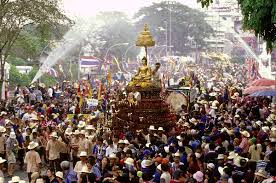
Besides the throwing of water, people celebrating Songkran may also go to a wat (Buddhist monastery) to pray and give food to monks. They may also cleanse Buddha images from household shrines as well as Buddha images at monasteries by gently pouring water mixed with a Thai fragrance (Thai: น้ำอบไทย) over them. It is believed that doing this will bring good luck and prosperity for the New Year. In many cities, such as Chiang Mai, the Buddha images from all of the city's important monasteries are paraded through the streets so that people can toss water at them, ritually 'bathing' the images, as they pass by on ornately decorated floats. In northern Thailand, people may carry handfuls of sand to their neighborhood monastery in order to recompense the dirt that they have carried away on their feet during the rest of the year. The sand is then sculpted into stupa-shaped piles and decorated with colorful flags.
Some people make New Year resolutions - to refrain from bad behavior, or to do good things. Songkran is a time for cleaning and renewal. Besides washing household Buddha images, many Thais also take this opportunity to give their home a thorough cleaning.
People in a tuk tuk getting soaked during Songkran in Chiang Mai
The use of chalk (Thai: ดินสอพอง) is also very common having originated in the chalk used by monks to mark blessings.
Some children having fun at the Bangkok Zoo during Songkran.
The throwing of water originated as a way to pay respect to people, by capturing the water after it had been poured over the Buddhas for cleansing and then using this "blessed" water to give good fortune to elders and family by gently pouring it on the shoulder. Among young people the holiday evolved to include dousing strangers with water to relieve the heat, since April is the hottest month in Thailand (temperatures can rise to over 100°F or 40°C on some days). This has further evolved into water fights and splashing water over people riding in vehicles.
Nowadays, the emphasis is on fun and water-throwing rather than on the festival's spiritual and religious aspects, which sometimes prompts complaints from traditionalists. In recent years there have been calls to moderate the festival to lessen the many alcohol-related road accidents as well as injuries attributed to extreme behavior such as water being thrown in the faces of traveling motorcyclists.
The water is meant as a symbol of washing all of the bad away and is sometimes filled with fragrant herbs.
Songkran is also celebrated in many places with a pageant in which young women demonstrate their beauty and unique talents, as judged by the audience. The level of financial support usually determines the winner, since, to show your support you must purchase necklaces which you place on your chosen girl.

Astrological calculation

Although the traditional calendar of Thailand like most of Southeast Asia utilizes a lunisolar calendar, the date of the new year was calculated on a purely solar basis. The term Songkran comes from Sanskrit "Sankranta" and means "a move or change" - in this case the move of the sun into the Aries zodiac. Originally this happened at the vernal equinox, but, as the Thai astrology did not observe precession, the date moved from March to April.
There is a similar named Indian Festival called as Sankrant or Makar Sankranti  celebrated on 14 January every year. Songkran as such has similarity to Indian festival of Holi.
The traditional new year celebration in Sri Lanka also coincides with the Thai new year.

Greetings

The traditional greeting is "สวัสดีปีใหม่" (sa-wat-dee pee mai), basically "Happy New Year". "Sawasdee" = also used for "hello" or "goodbye" (Romanized spellings may vary, i.e. "sawatdee", "sawadee" or "sawasdee"). "Pee" = year. "Mai" = new. Or "สุขสันต์ปีใหม่" (suk-san pee mai), "Suksan" = Happy.
However, most people use "สุขสันต์วันสงกรานต์" (suk-san wan songkran) - meaning "Happy Songkran Day" - since "pi mai" is more often linked with the first of January. "Suksan" is also used as an attribute for other days such as "Valentine's Day" ("สุขสันต์วันแห่งความรัก", suk-san wan haeng khwam rak) = Happy Valentine's Day.


9/21/09

Pattaya

Pattaya

From Wikipedia, the free encyclopedia


Pattaya
พัทยา
Pattaya City, เมืองพัทยา
Pattaya Beach

Seal
Location of Pattaya on the Gulf of Thailand
Pattaya is located in Thailand
Pattaya
Pattaya
Coordinates: 12°55′39″N 100°52′31″E / 12.9275°N 100.87528°E / 12.9275; 100.87528
Country Thailand
Province Chonburi
Mueang Mueang Pattaya
Government
 - Type Self-administrating municipality
 - Mayor Ittipol Khunplome
Area
 - Total 22.2 km2 (8.6 sq mi)
Population (2007)
 - Total 104,318
 - Density 4,699/km2 (12,170.4/sq mi)
  Registered residents only
Time zone Thailand (UTC+7)
ISO 3166-2 TH-S
Website www.pattaya.go.th
Mueang Pattaya surrounded by Amphoe Bang Lamung in Chon Buri Province.


Pattaya  is a city in Thailand, located on the east coast of the Gulf of Thailand, about 165 km southeast of Bangkok located within but not part of Amphoe Bang Lamung (Banglamung) in the province of Chonburi.
The city of Pattaya is a self governing municipal area which covers the whole tambon Nong Prue (Nongprue) and Na Kluea (Naklua) and parts of Huai Yai and Nong Pla Lai. It is located in the heavily industrial Eastern Seaboard zone, along with Si Racha (Sri Racha), Laem Chabang, and Chon Buri (Chonburi).
Pattaya is also the center of the Pattaya-Chonburi Metropolitan Area, the conurbation in Chonburi Province.

History

Pattaya's name evolved from the march of Phraya Tak (later King Taksin) and his army from Ayutthaya to Chanthaburi. This took place before the fall of the former capital to the Burmese invaders in 1767.

When his army arrived at the vicinity of what is now Pattaya, he encountered the troops of Nai Klom, who tried to intercept him. When the two leaders met face to face, Nai Klom was awed by Phraya Tak's dignified manner and his army's strict discipline. He then surrendered without a fight. The place the two armies confronted each other was called Thap Phraya, which means the Army of the Phraya. This was later changed to Phatthaya, which happens to mean the wind blowing from the southwest to the northeast at the beginning of the rainy season. Today the city is officially know as Pattaya.
For centuries, Pattaya was a small fishing village. But a change occurred on April 26, 1961, when the first group of about 100 American servicemen who were fighting in the Vietnam War arrived in Pattaya for relaxation. From this beginning, Pattaya became a popular beach resort which now attracts hundreds of thousands of visitors. Fishermen's huts along the beach were replaced by resort hotel and shopping malls. Fishing vessels were adapted to become tourist boats.

Demographics

The city (Mueang) had 104,318 registered inhabitants in 2007. But like Bangkok Metropolis, that figure excludes the large number of people who work in Pattaya but remain registered in their hometowns, and many long-term expatriate visitors. Including non-registered residents, the population numbers around 300,000 at any given time. Other estimates put the figure as high as 500,000.

Geography

Pattaya, located off the Gulf of Thailand, is approximately 145 km south of the city of Bangkok, surrounded by Bang Lamung District.
The city of Pattaya is a special municipal area which covers the whole tambon Nong Prue (Nongprue) and Na Kluea (Naklua) and parts of Huai Yai and Nong Pla Lai. Bang Lamung township which forms the northern border of Pattaya covers parts of the tambon Bang Lamung (Banglamung), Nong Pla Lai and Takhian Tia. Bang Sali is on the southern border of Pattaya.
"Greater Pattaya" occupies most of the coastline of Banglamung (one of the eleven districts that comprise Chonburi Province). It is divided into a larger northern section which spans the areas to the east of Naklua Beach (the most northern beach) and Pattaya Beach (the main beach) plus the Buddha Hill headland (immediately south of Pattaya Beach), and a smaller southern section covering the area to the east of Jomtien Beach (which lies directly south of Buddha Hill) including Dongtan Beach.

Administration

Pattaya city has been administered under a special autonomous system since 1978. It has a status comparable to a municipality and is separately administered by the mayor of Pattaya city who is responsible for making policies, organizing public services and supervising all employees of Pattaya city administration.

Climate

Pattaya has a tropical wet and dry climate, which is divided into the following seasons: warm and dry (November to February), hot and humid (March to May), and hot and rainy (June to October).
Weather data for Pattaya
Month Jan Feb Mar Apr May Jun Jul Aug Sep Oct Nov Dec
Average high °C 30.7 31.0 31.8 32.9 32.4 31.6 31.3 31.1 31.0 30.6 30.4 29.9
Average low °C 23.0 24.3 25.4 26.4 26.5 26.5 26.0 26.0 25.1 24.2 23.4 22.2
Precipitation mm 13.7 12.0 52.5 61.6 154.6 149.9 87.0 98.6 217.1 242.6 82.8 6.4
Average high °F 87 88 89 91 90 89 88 88 88 87 87 86
Average low °F 73 76 78 80 80 80 79 79 77 76 74 72
Precipitation inches 0.54 0.47 2.07 2.43 6.09 5.9 3.43 3.88 8.55 9.55 3.26 0.25
Source: World Weather Information ServiceNov 2007

Beaches and islands

Pattaya Bay Panorama.jpg

Pattaya along the beach
Pattaya Beach at sunset.
The main sweep of the bay area is divided into two principal beachfronts. Pattaya Beach is parallel to city centre, and is the main destination for bathers and loungers with the section from Central Road (Pattaya Klang) south to the harbor forming part of the core of the town's restaurants, motorcycle hire, and night attractions.
Jomtien Beach (Thai: หาดจอมเทียน) in the southern part of the bay area is divided from Pattaya beach by the promontry of Pratumnak Hill, just south of the city, and is mainly a residential area with luxury developments, beachside hotels, bungalow complexes, condominiums and restaurants. It offers of watersport activities such as jet skis, parasailing and small sail boat hire. A proposed 91-floor Ocean One Tower ("O1") with an overall height of 367 meters, would be the tallest building in Thailand and one of the tallest residential buildings in the world.The Jomtien district is the location of one of the largest resorts in Asia, the 4000+ room Ambassador City Jomtien.
Offshore islands include Mu Ko Larn (หมู่เกาะล้าน) , the "Near Islands", Ko Larn (main island), Ko Sak and Ko Krok located 7.5 km from the western shores of Pattaya Ko Larn (Thai: เกาะล้าน), or "Coral Island", Mu Ko Phai (หมู่เกาะไผ่), the "Far Islands", Ko Phai (main island), Ko Man Wichai, Ko Hu Chang and Ko Klung Badan, located offshore further west of the "Near Islands", and Ko Rin, located offshore to the southwest, south of Mu Ko Phai. Most of the islands in the group are accessible by speedboat in less than 15 minutes and by ferry taking about 45 minutes. The names "Near Islands", "Far Islands" and "Coral Island" are used for touristic purposes only and do not correspond to any naming conventions of the island groups and are not shown on maritime charts published by the Hydrographic Service of the Royal Thai Navy. Many of the islands have tourist beaches and offer scuba diving activities.

Transportation

Road
  1. By the Bangkok-Chon Buri-Pattaya Motorway (Highway No.7) The motorway is linked with Bangkok’s Outer Ring Road., (Highway No. 9) and there is also another entrance at Si Nakharin and Rama IX Junction.
  2. By Bang Na-Trat Highway (Highway No. 34) From Bang Na, Bang Phli, across the Bang Pakong River to Chon Buri there is a Chon Buri’s bypass that meets Sukhumvit Road., (Highway No. 3, passing Bang Saen Beach, Bang Phra to Pattaya.
City roads
  • Pattaya 1 Road ("Beach Road"): this street runs parallel to the beach
  • Pattaya 2 Road: this street runs approximately 400 meters parallel to Pattaya 1 Road.
  • Pattaya 3 Road: this is Pattaya’s outer-ring road which connects North, South and Central Pattaya.
  • Thap Phraya Road: this street connects Pattaya 2 to Jomtien Road.
  • Thep Prasit Road: this street connects Thap Phraya Road to Sukhumvit Road.
Rail
A daily service operates between Pattaya and Hualumphong Station in Bangkok.
Monorails
The city plan to construction 3 lines of monorail system, by a budget of 4,000 million baht.[
Bus
Intercity transport is usually through one of two bus stations, one for Bangkok and one for other destinations. Pattaya is served by frequent bus services from Bangkok’s Northern Bus Terminal (Morchit) and the Eastern Bus Terminal (Ekhamai). Busses from Pattaya serve nearby provincial towns and direct long distance routes serve many province capitals.
City and suburban services are provided mainlyby Songthaew (public passenger pick-up vehicle), popularly nick-named ‘Baht-buses’. A public bus service began in 2006.
Taxis
A metered taxi service began in late 2007. Motorcycle taxis generally operate in the town and suburbs and are mainly used for short distances.
Air
Pattaya is about 1½ hours, or 120 km by road from Suvarnabhumi Airport, the Bangkok international hub. By road, it is accessed from Sukhumvit Road and Motorway 7 from Bangkok. Pattaya is also served through U-Tapao International Airport which is 45 minutes drive from the city.

Tourist Destinations

Attractions

The Wat Khao Phra Bat temple overlooking Pattaya Bay features a Buddha statue more than 18 meters tall.
Nong Nooch Tropical Botanical Garden
Pattaya Park Tower.
Birds Eye View, from Pattaya Park Tower, Pattaya city.
The Sanctuary of Truth.
Once a fishing town, Pattaya first boomed as an R&R destination during the Vietnam War and developed into a family-orientated seaside destination. The Tourist Authority of Thailand claims 5,338,000 visitors for 2005 (up 6.5% from 2004), of which two-thirds were from abroad.
Activities include playing golf (21 golf courses within 1 hour of Pattaya,) go-cart racing, and visiting different theme parks and zoos such as the Elephant Village, where demonstrations of training methods and ancient ceremonial re-enactments are perfomed daily. The private Sri Racha Tiger Zoo features tigers, alligators, and other animals in daily shows. The Vimantaitalay tourist submarine offers underwater trips underwater to see corals and marine life just a few kilometers offshore. Nong Nooch Tropical Botanical Garden about 15 kilometers south of Pattaya is a 500-acre (2.0 km2) site of botanical gardens and an orchid nursery where cultural shows with trained chimpanzees and elephants are presented.
Other attractions in Pattaya include The Million Years Stone Park, Pattaya Crocodile Farm, Pattaya Park Beach Resort Water Park, Funny Land Amusement Park, Siriporn Orchid Farm, Underwater World Pattaya (world class aquarium), the Thai Alangkarn Theater Pattaya (cultural show), Bottle Art Museum, Ripley's Believe It or Not Museum, and Underwater World (อันเดอร์วอเตอร์ เวิลด์), an aquarium where there is a collection of marine species in the Gulf of Thailand including sharks and stingrays. Khao Phra Tam Nak or Khao Phra Bat (เขาพระตำหนัก หรือ เขาพระบาท) is a small hill located between South Pattaya and Jomtien Beach that provides a panoramic view of the city of Pattaya and its crescent bay. The hill is topped by Wat Khao Phra Bat, a temple, and the monument of Kromluang Chomphonkhetudomsak, who is regared as the “founding father of the modern Thai navy.” The Sanctuary of Truth (ปราสาทสัจธรรม) is a large wooden structure constructed in 1981 by the sea at Laem Ratchawet, that was conceived from the vision that human civilization has been achieved and nurtured by religious and philosophical truth.
Mini Siam (เมืองจำลองพัทยา) is a miniature model village which celebrates the heritages of Thailand with replicas of the most famous monuments and historical sites including the Temple of the Emerald Buddha, Democracy Monument, Bridge over the River Kwai, and Prasat Hin Phimai. Models of the Tower Bridge of London,Eiffel Tower, the Statue of Liberty and Trevi Fountain are also displayed in the section called “mini world." Wat Yanasangwararam Woramahawihan (วัดญาณสังวรารามวรมหาวิหาร) is a temple constructed in 1976 for Somdet Phra Yanasangwon, the present Supreme Patriarch and later supported by His Majesty the King. Within the compound of the temple are a replica of the Buddha’s footprint, and a large Chedi containing the relics of the Lord Buddha.

Activities

Bungee Jump
Bungee jumping is provided in Jomtien Beach.
Leisure flying
Sport and leisure flying and lessons are available.
Horse Riding
There are several facilities that provide training in riding, cross-country jumping and polo.
Motor Sports racing
There are facilities which provide a cart circuit with separate lanes for professionals and amateurs.
Fitness and sports
Artificial cliff climbing, boxing, yoga, squash, tennis court, etc., are offered at several locations.
Spa
Many kinds of massage are available including Thai massage, foot massage, oil massage and reflexology massage.
Diving
A popular destination in Pattaya for diving is the wreck of the Hardeep which was sunk by the allies in the Second World War. The wreck lies on its starboard side at a maximum depth of 26 meters. Other popular dive destinations near Pattaya include the islands of Ko Rin, Ko Lan, Ko Man Wichai, Ko Hu Chang, Ko Khrok, Ko Sak, and the wrecks of HTMS Khram and HTMS Kut.
Food specialities
Local culinary specialities include Chaeng Lon, a hand molded, charcoal-grilled small bun of coconut on a stick, Hoi Cho, a Chinese delicacy, is Chonburi's famous dish that uses a special kind of sea crab as the main ingredient, and Khao Lam, a specialty is made with sticky rice, sugar and coconut cream cooked in specially-prepared bamboo tubes. Chonburi has an abundance of fresh seafood and dried fruits. Due to the large number of residents from (Isaan), north-eastern dishes such as Spicy Papaya Salad (Somtum) and Spicy Sour Chopped Pork Salad (Larb) are widely available.

] Nightlife

A pattaya street at dusk
The city and its suburbs have a very large number of bars, night clubs and discotheques, massage parlors, and hourly hotels. Major hotels also operate restaurants, cocktail lounges, discothèques, nightclubs and supper clubs which offer food, drinks, music and international entertainment. The Walking Street, a pedestrian area near the beach is the main concentration of Pattaya's nightlife that has contributed to the city's reputation as a major destination for sex tourism. Boyztown and Sunee Plaza provide locations for the gay community. Muay Thai (Thai boxing) matches aimed at tourists can be seen at several open-air beer bar complexes.

Events & Festivals

The Pattaya Songkran festival that takes place each year on 18-19 April differs from the rest of Thailand in several aspects. The event includes beauty pageants, musical performances, cultural shows, fireworks, and water sports competition.
Pattaya International Music Festival is held annually in the month of March. On different stages, a bandwagon presents several styles of music performed by Thai and international artists.

Creative Arts

Western creative arts increase concomitant with the rise the number of expat residents. There are several art galleries, and the the Pattaya Players, a troupe of amateur thespians established in January 2008 provides a variety of theatrical productions .
A restaurant in central Pattaya.

Property

Driven by its popularity as both a holiday destination, and a location Western expatriates, Pattaya is an area of extensive property development, especially hotels, condominiums, and housing estates. Steadily rising prices of land and buildings have also led to investment and speculation contributing to growth the town's economy.

Health Care

Large hospitals in the area include Bangkok Pattaya Hospital, Pattaya International Hospital, Banglamung Hospital, and Pattaya Memorial Hospital. Many foreign tourists have dental and medical care in Pattaya, though Bangkok is far more popular for as a medical tourist destination.

Populace

Most of the officially registered Pattaya residents are of Thai-Chinese ancestry. However, due to the tourist industry, many people from the north-east (known as Isaan, it is the poorest region of Thailand) have come to work in Pattaya. For this reason, it is not uncommon to hear the Isaan dialect (similar to Laotian).

Media and communications

Several local foreign language newspapers and magazines are published either daily, weekly, or monthly, especially in English and German. The English newspapers include the Pattaya Mail, Pattaya Today, and Pattaya Times. Cable television provides many foreign language programs, as well as local news from Pattaya in English. The official Thailand Survival Guide Pattaya Edition offers further information and contains a directory of more than 16,000 businesses in Pattaya. Landline telephones, satellite phones, mobile phone systems, internet access (via ADSL), post offices and parcel services are all available in the province.

Patong Beach

Patong Beach


View of Patong Beach, with condominium tower.
Patong Beach (Thai หาดป่าตอง) refers to a beach on Phuket's west coast, and to the town adjoining it. It is the main tourist resort in Phuket. It also contains an important center of Phuket's nightlife and is the center of inexpensive shopping on the island. The beach became popular with Western tourists, especially Europeans, in the late 1980s. Numerous large hotels and chain hotels are located there.
Patong Beach is as equally famous for its nightlife as also the 2-kilometer beach that runs the entire length of Patong’s western side. Nightlife is centered on two main areas Bangla Road and Paradise Complex, with Bangla Road being predominantly straight and Paradise Complex being predominantly gay. Both roads are lined with many themed bars, discotheques, and go go bars. Prostitution is culturally acceptable, especially on Bangla Road where there are many older Western men drinking with much younger Thai women and transvestites.
On December 26, 2004, Patong Beach along with many other areas along the western coast of Phuket and Thailand were struck by a tsunami caused by the 2004 Indian Ocean earthquake. The wave caused a great deal of destruction to the waterfront of the beach and immediately inland, and many people were killed there. Patong was one of the worst affected areas of Phuket, although the destruction was not nearly as bad as nearby in Khao Lak.
View of the Patong Beach facing

9/18/09

The Thai Language

Though it's not really necessary to get by, you will undoubtedly have an easier and more enjoyable experience in Thailand from any time you spend learning Thai. Most Thais don't expect a foreigner to be able to speak any of their language, and are often visibly surprised if you can string a few sentences together. It's also encouraging how many people will tell you that you poot tai geng (speak Thai well), no matter how limited your command of the language really is. Even with only a fairly small vocabulary, you will find it a lot easier to get discounted prices at shops and markets (rah kah poot tai dai, "Thai speaker prices) and to make friends amongst the locals.
Thai, like Chinese and Vietnamese, is a tonal language meaning that the same word can have a completely different meaning depending on it is pronounced. In total, there are 5 tones: Mid tone, high tone, low tone, rising tone and falling tone. A common example of the difficulty of tones in Thai is the word mai, whose meanings include "wood", "not", "silk", "burn", and "new" depending on what tone is used to pronounce it.
It's not always this bad though, and the context means you will often be understood even if the tone is wrong. In some cases though, the context is unlikely to help very much and you will have to get the pronunciation correct in order to be understood - glai (mid tone, meaning "far away") and glâi (falling tone, meaning "near") is a good example. It takes a long time to learn how to pronounce the tones correctly, and it's all too easy to make an embarrassing faux pas or inadvertently offend simply by getting the tone wrong on one word. Luckily most Thais realize how difficult it is for foreigners to speak their language, and are generally quite tolerant of any mistakes - which is just as well really.
Though there's no real way to know how to pronounce the tones except by listening to a native speaker, the rising and falling tones tend to be the easiest ones to pick up. The rising tone is approximately similar to the inflection used in English to indicate a question, the falling tone roughly like calling someone's name from far away. The low and high tones are respectively pronounced near the relative bottom and top of your vocal range.
Try to avoid speaking slowly and hesitantly, as this will distort the tone on the word and make you much more difficult to understand than if you spoke confidently. When speaking fairly quickly even the Thais routinely don't pronounce each and every tone, as there's simply not enough time to do so. If your tones aren't perfect, you stand a much chance of being understood by talking at the same normal speed, rather than hesitantly. You'll know you're well on the way to getting it right if you start being told that you poot tai chat (speak Thai clearly) rather than simply geng (well).
Tones on this website are indicated using tone marks on the first vowel of each syllable. If there is no tone mark, it is pronounced with a mid tone. Other tones are shown as follows:

Thai cuisine

Thai cuisine


Thai seafood curry
Tom yum: spicy, sour soup
A street vendor selling different types of sala pao (steamed buns) from a street stall fixed to the side car of his motorbike
Thai cuisine refers to typical foods, beverages, and cooking styles common to the country of Thailand in Southeast Asia. Thai Cuisine is well-known for being hot and spicy and for its balance of five fundamental flavors in each dish or the overall meal - hot (spicy), sour, sweet, salty, and bitter (optional).
Although popularly considered as a single cuisine, Thai food would be more accurately described as four regional cuisines corresponding to the four main regions of the country: Northern, Northeastern (or Isan), Central, and Southern, each cuisine sharing similar foods or derived from those of neighboring countries. Southern curries, for example, tend to contain coconut milk and fresh turmeric, while northeastern dishes often include lime juice. The cuisine of Northeastern (or Isan) Thailand is heavily influenced by Laos. Many popular dishes eaten in Thailand were originally Chinese dishes which were introduced to Thailand mainly by Teochew people who make up the majority of the Thai Chinese. Such dishes include jok, kway teow rad na, khao kha moo (also known as moo pa-loh) and khao mun gai.
Thai food is known for its enthusiastic use of fresh (rather than dried) herbs and spices as well as fish sauce. Thai food is popular in many Western countries.

Serving

Thai meal in a village temple
Tom yum kung nam khon (prawn tom yum with coconut milk)
Instead of a multiple main course with side dishes found in Western cuisine, a Thai full meal typically consists of either a single dish or rice khao (Thai: ข้าว) with many complementary dishes served concurrently and shared by all.
Nowadays, Thai food is eaten with a fork and spoon but traditionally, it was eaten with the right hand. Only noodle dishes (and then mainly only the noodle soups) are eaten with chopsticks and a spoon.
Rice is a staple component of Thai cuisine, as it is of most Asian cuisines. The highly prized, sweet-smelling jasmine rice is indigenous to Thailand. This naturally aromatic long-grained rice grows in abundance in the verdant patchwork of paddy fields that blanket Thailand's central plains. Steamed rice is accompanied by highly aromatic curries, stir-frys and other dishes, incorporating sometimes large quantities of chillies, lime juice and lemon grass. Curries, stir-frys and others may be poured onto the rice creating a single dish called khao rad gang (Thai: ข้าวราดแกง), a popular meal when time is limited. Sticky rice (khao niao, Thai: ข้าวเหนียว) is a unique variety of rice that contains an unusual balance of the starches present in all rice, causing it to cook up to a sticky texture. It is the daily bread (so to speak) of Laos and substitutes ordinary rice in rural Northern and Northeastern Thai cuisine, where Lao cultural influence is strong.
Noodles, known in much of Southeast Asia by the Chinese name kway teow (Thai: ก๋วยเตี๋ยว), are popular as well but usually come as a single dish, like the stir-fried Pad Thai (Thai: ผัดไทย) or noodle soups. Many Chinese cuisine are adapted to suit Thai taste, such as kway teow rua (Thai: ก๋วยเตี๋ยวเรือ), a sour and spicy rice noodle soup.
Nam prik (Thai: น้ำพริก) is Thai chilli sauce or paste. Each region has its own special versions. It is prepared by crushing together chillies with various ingredients such as garlic and shrimp paste using a mortar and pestle. It is then often served with vegetables such as cucumbers, cabbage and yard-long beans, either raw or blanched. The vegetables are dipped into the sauce and eaten with rice. Nam prik may also be simply eaten alone with rice or, in a bit of Thai and Western fusion, spread on toast.
Thai food is generally eaten with a fork and a spoon. Chopsticks are used rarely, primarily for the consumption of noodle soups. The fork, held in the left hand, is used to push food into the spoon. However, it is common practice for Thais and hill tribe peoples in the North and Northeast to eat sticky rice with their right hands by making it into balls that are dipped into side dishes and eaten. Thai-Muslims also frequently eat meals with only their right hands.
Often Thai food is served with a variety of spicy condiments to embolden dishes. This can range from dried chilli pieces, or sliced chilli peppers in rice vinegar, to a spicy chilli sauce such as the nam prik mentioned above.

Ingredients

Fresh herbs, fresh spices and vegetables sold at a stall in Thanin Market, Chiang Mai, Thailand.
Ingredients for green curry
The ingredient found in almost all Thai dishes and every region of the country is nam pla (Thai น้ำปลา), a very aromatic and strong tasting fish sauce. Shrimp paste, a combination of ground shrimp and salt, is also extensively used.
Thai dishes in the Central and Southern regions use a wide variety of leaves rarely found in the West, such as kaffir lime leaves (bai makrut, Thai ใบมะกรูด). The characteristic flavour of kaffir lime leaves appear in nearly every Thai soup (e.g., the hot and sour Tom yam) or curry from those areas. It is frequently combined with garlic, galangal, lemon grass, turmeric and/or fingerroot (krachai), blended together with liberal amounts of various chillies to make curry paste. Fresh Thai basil is also used to add fragrance in certain dishes such as Green curry. Thais also use grapow (kraphao) (holy basil), which has a distinctive scent of clove.
Other typical ingredients are the small green Thai eggplants, tamarind, palm and coconut sugars, lime juice, coconut vinegar, and coconut milk. A variety of chillies and spicy elements are found in most Thai dishes, including the small and very hot phrik khi nu (Thai pepper [a.k.a. bird, bird's eye, or mouse-dropping chilli]).
Further ingredients include pahk chee (cilantro or coriander), rahk pahk chee (cilantro/coriander roots), curry pastes, pong kah-ree (curry powder), see-ew dahm (dark soy sauce), gung haeng (dried shrimp), pong pa-loh (five-spice powder), tua fahk yao (long beans or yard-long beans), nahmahn hoi (oyster sauce), rice and tapioca flour, and nahm prik pao (roasted chilli paste).
Although broccoli is often used in Asian restaurants in the west in pad thai and rad na, it was never actually used in any traditional Thai food in Thailand and is still rarely seen in Thailand. Usually, kana (gailan) is used.

Famous dishes

Many Thai dishes are familiar in the West. In many dishes below, different kinds of protein can be chosen as the ingredient, such as beef, chicken, pork, duck, tofu or seafood.

Breakfast dishes

  • Jok (Thai: โจ๊ก) - a rice porridge very commonly eaten in Thailand for breakfast. Similar to the rice congee eaten in other parts of Asia.
  • Khao Tom (Thai: ข้าวต้ม) - a Thai style rice soup, usually with pork, chicken or shrimp.

Individual dishes


Pad Thai (close up)
Khao mun gai
  • Khao Pad (Thai: ข้าวผัด) - One of the most common dishes in Thailand, fried rice, Thai style. Usually with chicken, beef, shrimp, pork, crab or coconut or pineapple, or vegetarian ( jay (Thai: เจ).
  • Pad Thai (Thai: ผัดไทย) - rice noodles pan fried with fish sauce, sugar, lime juice or tamarind pulp, chopped peanuts, and egg combined with chicken, seafood, or tofu.
  • Rad na (Thai: ราดหน้า) - wide rice noodles in gravy, with beef, pork, chicken, shrimp, or seafood.
  • Khao pad naem (Thai: ข้าวผัดแหนม) - fried rice with fermented sausage (typically from the Northeast)
  • Pad see ew (Thai: ผัดซีอิ๊ว) - noodles stir-fried with see ew dum (thick sweet soy sauce) and nahm plah (fish sauce) and pork or chicken.
  • Pad kee mao (Thai: ผัดขี้เมา) - noodles stir-fried with Thai basil
  • Khao khluk kapi (Thai: ข้าวคลุกกะปิ) - rice stir-fried with shrimp paste, served with sweetened pork and vegetables.
  • Khanom chin namya (Thai: ขนมจีนน้ำยา) - round boiled rice noodles topped with a fish based sauce and eaten with fresh leaves and vegetables.
  • Khao soi (Thai: ข้าวซอย) - crispy wheat noodles in sweet chicken curry soup (a Northern dish)
  • Khao pad gai (Thai: ข้าวผัดไก่) - fried rice with chicken
  • Khao mun gai (Thai: ข้าวมันไก่) - rice steamed with garlic, with boiled chicken, chicken stock and a dipping sauce
  • Gai pad grapao (Thai: ไก่ผัดกะเพรา) - minced chicken with garlic, chillies, and Holy basil
  • Gai pad med mamoung himaphan (Thai: ไก่ผัดเม็ดมะม่วงหิมพานต์) - juicy chunks of chicken with cashew nuts and chillies

Central Thai shared dishes

Tod man pla krai with dipping sauce
Massaman curry
  • Tom yam (Thai: ต้มยำ) - hot & sour soup with meat. With shrimp it is called Tom yam goong or Tom yam kung (Thai: ต้มยำกุ้ง), with seafood (typically shrimp, squid, fish) Tom yam talae (Thai: ต้มยำทะเล), with chicken Tom yam gai (Thai: ต้มยำไก่).
  • Gai Pad Khing (Thai: ไก่ผัดขิง) - chicken stir-fried with sliced ginger.
  • Tom kha gai (Thai: ต้มข่าไก่) - hot sweet soup with chicken and coconut milk.
  • Saté (Thai: สะเต๊ะ) - grilled meat, usually pork or chicken, served with cucumber salad and peanut sauce (actually of Indonesian origin, but now a popular street food in Thailand).
  • Red curry (Gaeng Phet lit. 'hot curry', Thai: แกงเผ็ด) - made with copious amounts of dried red chillies
  • Green curry (Gaeng khiew-waan, Thai: แกงเขียวหวาน) - green curry, made with fresh green chillies and flavoured with Thai basil, and chicken or fish meatballs. This dish is one of the spiciest of Thai curries.
  • Massaman curry (Thai: แกงมัสมั่น) - an Indian style curry, usually made by Thai-Muslims, containing roasted dried spices, such as coriander seed, that are rarely found in other Thai curries.
  • Pad prik (Thai: ผัดพริก) - usually beef stir fried with chilli, called Neua pad prik (Thai: เนื้อผัดพริก)
  • Pad kraphao (Thai: ผัดกะเพรา) - beef, pork or chicken stir fried with Thai holy basil.
  • Pad pak ruam (Thai: ผัดผักรวม) - stir fried combination of vegetables depending on availability and preference.
  • Phanaeng curry (Thai: พะแนง) - a mild creamy curry with beef (Phanaeng nuea, Thai: พะแนงเนื้อ), chicken, or pork. It includes some roasted dried spices similar to Massaman curry.
  • Tod man (Thai: ทอดมัน) - deep fried fishcake made from knifefish (Tod man pla krai, Thai: ทอดมันปลากราย) or shrimp (Tod man kung, Thai: ทอดมันกุ้ง)
  • Boo Jah (Thai: ปูจ๋า) - crab cakes with pork, garlic, and pepper served with a simple spicy sauce, such as Sri Rachaa sauce, sweet-hot garlic sauce, nahm prik pao (roasted chilli paste), or red curry paste and chopped green onions.
  • Choo-Chee Plah Ga-Pong (Thai: ฉู่ฉี่ปลากระพง) - snapper in choo-chee curry sauce (thick red curry sauce)

Northeastern shared dishes

The cuisine of Northeastern Thailand is shared with the cuisine of Laos, as Isan people are of Lao heritage and speak a language that is mutually intelligible with the Lao language.
Som tam (papaya salad), gai yang (grilled chicken) and khao niao (sticky rice) is a very popular combination
  • Som tam (Thai: ส้มตำ, IPA: som ɗam), known in Lao/Isan language as ตำมักหุ่ง (IPA: ɗam mak huŋ). grated papaya salad, pounded with a mortar and pestle. There are three main variations: Som tam poo (Thai: ส้มตำปู) with salted black crab, and Som tam Thai (Thai: ส้มตำไทย) with peanuts, dried shrimp and palm sugar and Som tam plara (Thai: ส้มตำปลาร้า) from north eastern part of Thailand (Isan), with salted gourami fish, white eggplants, fish sauce and long bean.
  • Larb (Lao:  Thai: ลาบ) - sour salads containing meat, onions, chillies, roasted rice powder and garnished with mint.
  • Nam Tok (Thai: น้ำตก) - made with beef and identical to larb, except that the beef is cut into thin strips rather than minced.
  • Yam (Thai: ยำ) - general name for any type of sour salad, such as those made with glass noodles (Yam Wun Sen, Thai: ยำวุ้นเส้น), or with seafood (Yam Talae, Thai: ยำทะเล).
  • Tom saep (Thai: ต้มแซบ) - Northeastern-style hot & sour soup
  • Gai yang (Thai: ไก่ย่าง) - marinated, grilled chicken
  • Suea Rong Hai (Thai: เสือร้องไห้) - grilled beef brisket
  • Khao niao (Thai: ข้าวเหนียว) - Glutinous rice is eaten as a staple food both in the Northeast as in the North of Thailand.
  • Nam prik num (Thai: น้ำพริกหนุ่ม) - dipping sauce made from roasted eggplant, green chillies, and garlic ground together in a mortar and pestle.

Desserts and drinks

Mo Geng, a cake mainly made of eggs
  • Kao niao ma muang (Thai: ข้าวเหนียวมะม่วง) - Sticky rice and ripe mango
  • Lod Chong Nam Ka Ti (Thai: ลอดช่องน้ำกะทิ) – Pandan flavored rice flour noodles in coconut milk
  • Kanom Tan (Thai: ขนมตาล) – Palm flavored mini cake with shredded coconut on top
  • Ruam Mit (Thai: รวมมิตร) – Chestnuts covered in flour, jackfruit, tapioca, and Lod Chong in coconut milk
  • Kanom Chun (Thai: ขนมชั้น) – multi-layers of pandan-flavored sticky rice flour mixed with coconut milk
  • Kanom Bua Loy (Thai: ขนมบัวลอย) – taro root mixed with flour into balls in coconut milk

Variations

Fried mang dah: giant water bugs
Throughout the country there are many interpretations and variations on these common dishes. Other dishes from the northern part of Thailand include unique sauces and exotic foods, such as raw beef, fermented fish paste, and deep fried insect larvae (also enjoyed in the Northeast). The culinary creativity even extends to naming: one tasty larva translates as "freight train" (rot duan; Thai: รถด่วน) and the smallest, hottest chillies are known as phrik khii nuu (Thai: พริกขี้หนู), literally "mouse dropping chillies". They are called that because of their size. In the Northeast, eating insects is common, and the giant water bug (mang dah; Thai: แมงดา) is popular.
The dish nam prik pla too (Thai: น้ำพริกปลาทู) is particularly common in central Thailand because of its low cost. It consists of deep fried Indian mackerel, Rastrelliger kanagurta (pla too) served with a dip made from shrimp paste and chilli (nam prik kapi). The fish are traditionally presented in pairs, placed head-to-tail on a round bamboo dish.

Culinary Tour Services

Culinary tours of Thailand have become increasingly popular in recent years. Along with golf focused vacations, food tours of Thailand have carved a niche for themselves. A number of companies currently offer culinary and/or cooking tours of Thailand.